



The State of Employee Storytelling: What We Saw in Q3 2026
As we think about the state of employee storytelling right now, we ask: what are employer brands prioritizing in their employee storytelling right now? What stories are they telling? And how is the creative evolving?
Every day, the Stories Inc. team is talking to employer brand, talent acquisition, recruitment marketing, and internal communications team as well as interviewing employees around the world. Once a quarter, we’re taking a step back from that day-to-day work to look at the bigger picture.
What the data tells us about the state of employee storytelling right now
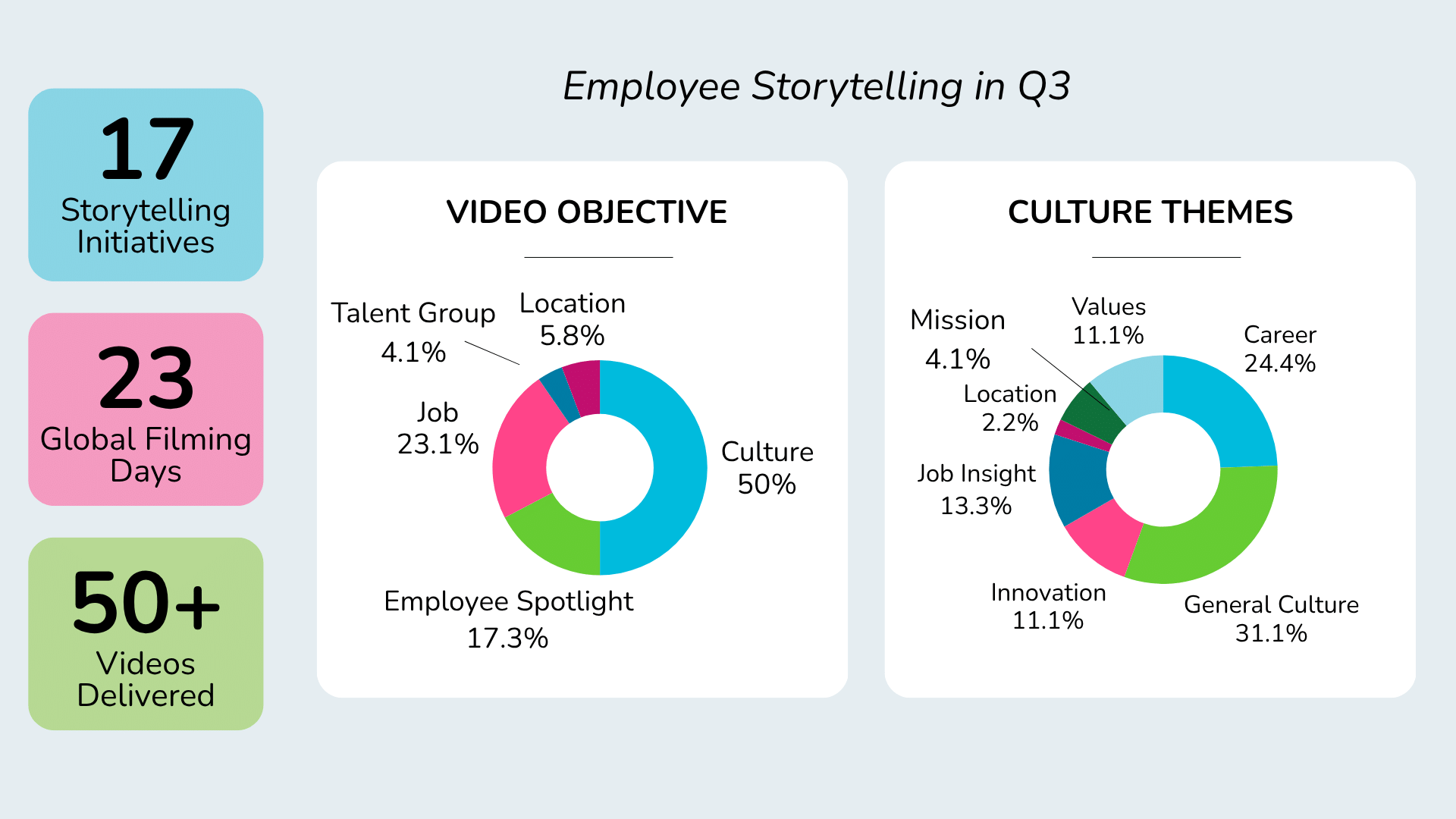
For Q3 2026, that meant looking across 17 storytelling initiatives, 23 global filming days, and 50+ videos delivered to identify the objectives, themes, and creative approaches brands are prioritizing right now. A busy Q3 gave us a lot of work to analyze—and some clear patterns emerged.
Universal storytelling is taking center stage
Rather than creating content exclusively around a particular talent group, location, or recruiting need, we’re seeing greater investment in broader, more universal stories about the employee experience. This is content that can work harder across audiences, channels, and use cases.
What we’re seeing:
- 50% of the videos we created in Q3 were designed to communicate culture, making it by far the most common video objective.
- General culture and career growth accounted for more than half of the culture themes explored, at 31% and 24%, respectively. Both have broad relevance, with stories that can resonate with candidates and current employees alike.
- Employee spotlights are becoming more holistic. Anecdotally, we’re seeing less emphasis on fitting an employee into a specific talent group or recruiting message. Instead, brands are telling more well-rounded stories about the person, including their experiences, motivations, interests, and career.
The takeaway: With job spotlights making up 23% of video objectives, targeted storytelling isn’t going away anytime soon. But brands seem to be balancing it with stories that have broader relevance, finding great human stories first and allowing them to work across multiple audiences and channels.
Career growth and innovation are having a moment
When we looked specifically at the culture themes represented in Q3 content, general culture led at 31.1%, followed by career growth at 24.4%. While job insights took the third spot, “innovation” was the next leading culture theme topic at 11%.
Career growth occupying nearly a quarter of the stories is particularly notable because it can speak to two audiences at once.
For candidates, career stories answer: Can I build a future here?
For current employees, they reinforce: You can keep building your future here.
That matters in a ‘job hugging’ market where people may be less eager to jump to their next opportunity and organizations are increasingly thinking about engagement, internal mobility, and retention alongside external hiring.
Interestingly, innovation also represented 11.1% of the themes we explored. That showed up in real time during Q3: brands increasingly want to tell stories about how they’re adapting, innovating, and approaching AI.
“Even projects we were already working on, we’re hearing, ‘Can we add a video about AI?’ in the middle of projects. People are trying to figure out how to communicate where they stand on it and how it ties to their culture.”
– Doyle Maurer, Creative Director at Stories Inc.
Shorter isn’t always better
For years, the dominant advice around social video has been to make it shorter. And shorter. And shorter. All in the effort to capture shrinking attention spans. Our Q3 work suggests a little more nuance.
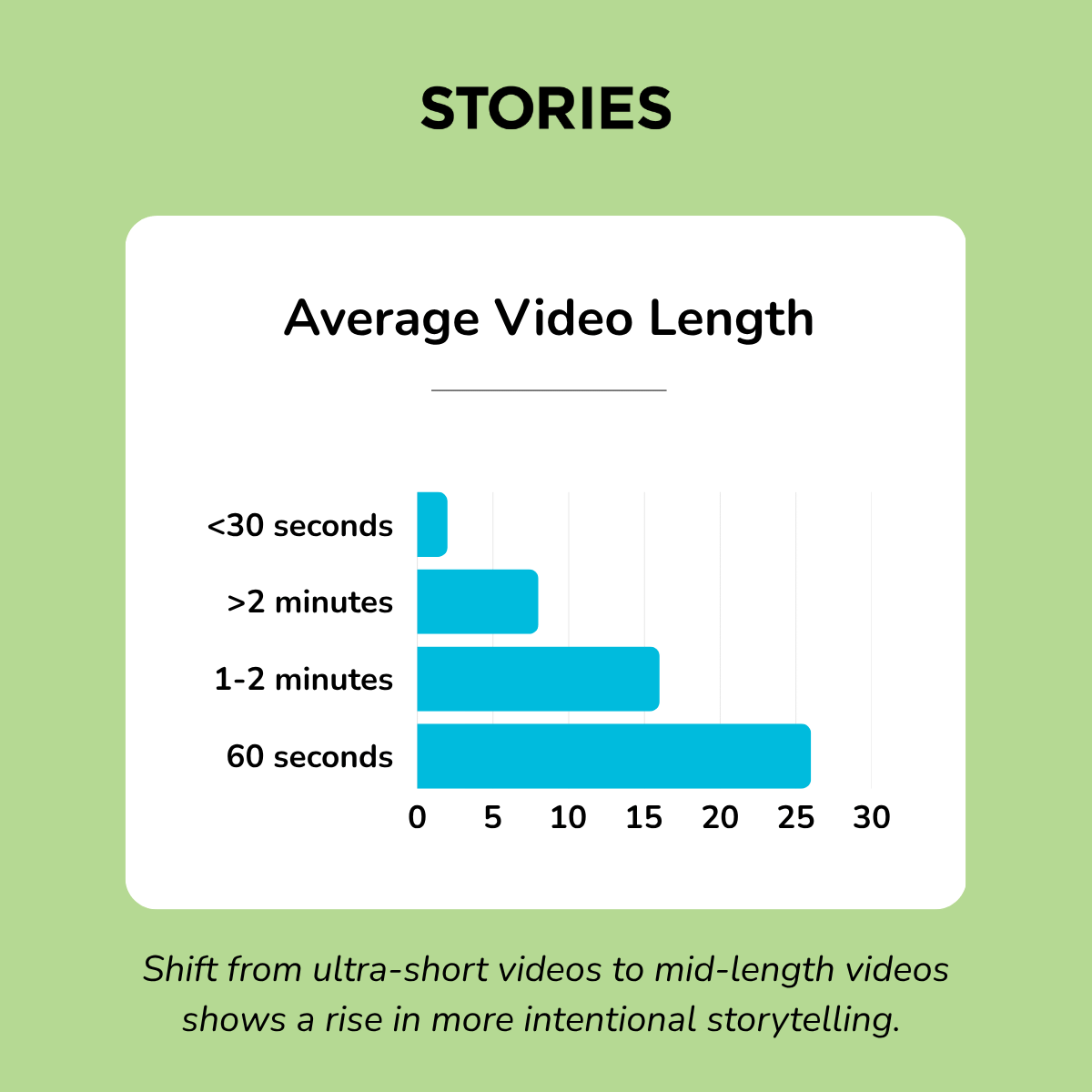
Videos around 60 seconds and 1–2 minutes were much more common than ultra-short videos under 30 seconds. Doyle connected that shift to what he calls the “trust economy.”
“There’s enough time to actually tell a story, and then it gives it the weight that it needs to actually convert people rather than just grab their attention as they’re scrolling.”
– Doyle Maurer, Creative Director at Stories Inc.
Attention still matters. But particularly in an age of endless content—and endless questions about whether what we see online is real—employee storytelling has another job: building trust.
Sometimes that requires giving a good story a little room to breathe.
Three bigger employee storytelling trends we’re seeing
As we think about the state of employee storytelling, the numbers tell us one part of the story.
But some of the most interesting trends from Q3 aren’t easily captured in a pie chart. They come from the projects themselves, the requests we’re hearing from clients, and the creative challenges our team is being asked to solve.
Two in particular stood out.
1. Events are becoming a catalyst for employee storytelling
Some of the best opportunities for employee storytelling are already on the company calendar.
We’re seeing brands increasingly build storytelling around major company moments, from annual summits and all-hands meetings to conferences, awards ceremonies, and other employee gatherings.
And that’s happening in two ways:
- Capture stories at the event. When employees are already gathering in one place, it creates a natural opportunity to capture their stories. Brands can make the most of that access with employee interviews, quick man-on-the-street content, event recaps, and evergreen culture stories.
- Create stories for the event. In other cases, the event creates the reason for the content. Brands are developing employee stories specifically to premiere at an all-hands, support a major company announcement, celebrate employees, or bring a new initiative to life.
We’ve seen both approaches in action this year. Two examples:
For Huntress, its annual Summer Summit brought employees together in one place, creating an opportunity to capture a wide range of employee stories while tapping into the energy of the event itself. Watch their event recap video:
For MBP, the storytelling happened before the event. As the company prepared to unveil its new 10-year vision at an all-hands meeting, leaders shared their own visions for the future through a series of letters. Those stories helped turn the launch of a corporate vision into something personal and employee-driven.
When it comes to events, smart content creators plan for the moment and beyond. With the right planning, an event can become a content engine for months to come. That means thinking about two types of content from the start:
- Timely content that captures the energy of the event, such as recaps, behind-the-scenes moments, social clips, or content tied to a specific announcement.
- Evergreen content that takes advantage of having employees together to capture culture stories, employee spotlights, leadership perspectives, job insights, and other content that can be used throughout the year.
From that same Huntress shoot, here is an evergreen video highlighting the people and passion that make working for Huntress so special. Perfectly aligned to their dark and neon brand guidelines, you’d never guess it was filmed in an empty conference room!
The takeaway: Think about the big moments already happening across your organization. They may be an opportunity to capture stories while your people are together, a reason to create stories that make the moment more meaningful, or both.
2. Employee storytelling is increasingly a retention and engagement strategy
Employee storytelling has traditionally been closely associated with talent attraction: show candidates what it’s like to work here so they can picture themselves joining the organization.
But increasingly, the audience is already inside the company. We’re seeing organizations invest in high-quality storytelling to support employee engagement, recognition, internal mobility, culture-building, and retention.
One global manufacturing client, for example, is using an employee storytelling series to spotlight different regions, functions, and products across a workforce of tens of thousands. The goal is to help employees understand how their individual work connects to a much bigger picture.
Shannon Edwards, Account Manager at Stories Inc., explained:
“It’s really building that education, but it’s also building that pride in work… not just your day-to-day, but having some insight the work being done all over the company and all over the world.”
Another global technology company is on year five of using employee stories to create an epic core value awards ceremony experience.
The work starts months in advance: Stories Inc. captures the moment employees discover they’ve won, their genuine reactions, and conversations with managers about why they were recognized. Those stories are then shared at the company-wide virtual award ceremony.
Over time, the series itself has become part of the tradition, with employees remembering past winners and anticipating who will be recognized next.
That’s the opportunity with internally-facing employee storytelling. Recognition doesn’t have to disappear after the applause. A career-growth story doesn’t have to live only on a careers site. And an employee’s experience of a company value can reinforce what that value means for thousands of colleagues.
What will the state of employee storytelling look like in Q4?
If there’s one overarching takeaway from Q3, it’s that employee storytelling is becoming broader in both audience and ambition.
Brands are investing in universal culture stories that can work across channels. They’re using stories to engage the employees they already have, not just attract the people they want to hire. They’re raising the creative bar. And they’re giving strong stories enough time—and enough employee voices—to build trust.
Every quarter brings a new set of projects, conversations, creative briefs, employee interviews, and priorities. We’ll keep taking a step back to see what those individual pieces tell us about the bigger picture.
Watch the full State of Employee Storytelling: Q3 2026 session to hear more from Shannon and Doyle and see the examples behind these trends: